The following is an excerpt from a blog I wrote for Project Coyote, an organization dedicated to strengthening protections wild carnivores and promoting human-wildlife coexistence. To read the entire blog, you can read it on their website. This piece was inspired by my decades of work spanning science, environment, and communications. As I iterate in the blog, language plays a strong role both in how we perceive our reality, and how we can create the positive change we wish to see in the world.
One of the properties I frequently drive past on my way home is a tree nursery, with a tiny corral at its entrance beside a busy road. A few weeks ago, I noticed that a small, young horse had been placed in the corral. In front is a sign that reads, FOR SALE: ANDALUSIAN HORSE. The colt, dappled gray and still slightly gangly, is likely no more than a year old. He paces his tiny, circular pen (perhaps thirty feet in diameter) all alone—with no other horses, people, or animals in sight—all day, every day, from what I can tell.
I wonder what pain and confusion this young animal must feel, to be torn from his mother and thrown on display in a dusty 30-foot prison, the smell of diesel exhaust from the adjacent truck route replacing the tender breath of his mother’s nuzzle, the grating sounds of revving engines and squealing breaks overpowering the nickers and whinnies of his brethren.
A horse’s wellbeing, according to horse care experts, is dependent on three core elements, often called the three F’s: friends, forage, and freedom. Friends refers to the intrinsic need that horses have for social connection—they rely on the security of being part of a herd, and build strong social bonds with other horses. Forage indicates the importance of providing horses with 24-7 access to hay or other grasses. Horses naturally spend much of their time grazing, and depend on frequent foraging to maintain gut health. Freedom means that horses are free to move, and to make choices about how they spend their time, and with whom.
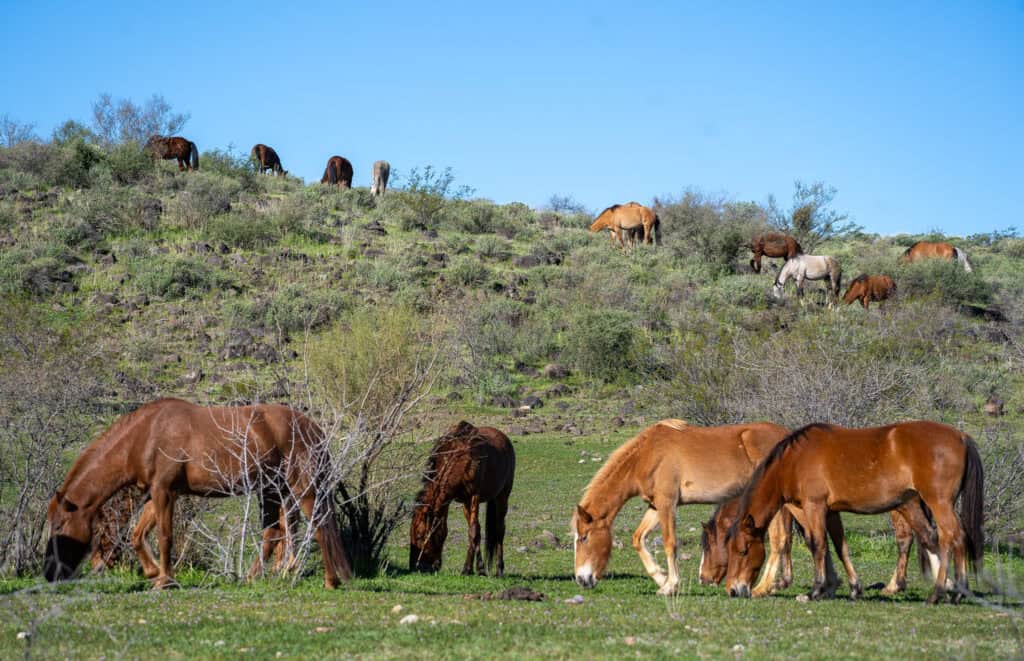
A band of wild horses grazing near the Salt River, Arizona (photo: Kristen Weiss)
Unfortunately, our human rubric for how we consider the welfare of other species—whether horses, dogs, cows, fish, or insects—typically fails to consider the full spectrum of an animal’s emotional needs. Similarly, while animal cruelty is a punishable crime, the definition of “cruelty” is alarmingly narrow. The treatment of the young horse I drive past every day, for example, would not be deemed as abuse as long as he is being fed hay and water each day, and not being physically beaten. The fact that he is a conscious being whose social and emotional needs are woefully neglected does not factor into consideration. Protections for wildlife are often even less stringent—hence why it is completely legal to run down and kill wolves and coyotes with snowmobiles in states like Idaho, Montana, and Wyoming, with complete disregard for intrinsic rights of these animals.
It is no secret that humans are walking contradictions. We are whiplashed with cognitive dissonance, hyper-rationalization, and sometimes willful ignorance, which help us defend our arbitrary moral boundaries even in the face of conflicting evidence or viewpoints. Our colonial-capitalist Western society simultaneously encourages us to spend thousands of dollars to spoil our dogs and cats while turning a blind eye to the mass murder of millions of cows, chickens, pigs, and sheep. Leaving your dog outside in winter could put you in jail; so, too could rescuing a sick, mutilated calf from a factory farm. We kill wild carnivores to protect deer or cattle, so that we can kill those animals ourselves. We name revered sports teams after panthers, wolves, and even coyotes—presumably out of respect for their remarkable prowess and innate survival abilities—while also demanding that these species be eradicated as “problem animals” for those very same characteristics.
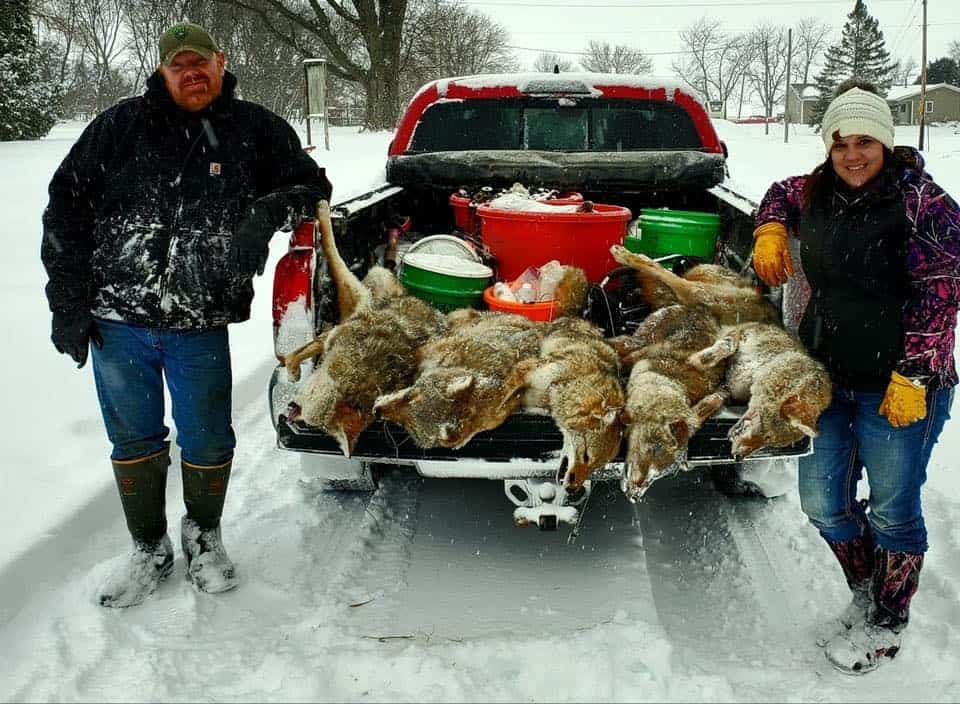
The business owners of Dunlap LURES make frequent public posts on social media bragging about their mass killings and using language that objectifies, minimizes, and vilifies wild animals (and does the same with anyone who expresses dissent in the post comments). Their treatment of these animals harkens to our violent settler-colonial past, which relies on the assumption that (white) humans supersede all other beings, and have the right to terrorize said beings for their own amusement or financial gain. (photo: public facebook page of the business Dunlap Lures)
Hidden in plain sight (and words)
The dissonance in our actions is not always due to maleficent intent; much of it stems from an obfuscation of language surrounding violence and death. We’ve been trained to think of hunting as “recreation” and killing as “sport,” rather than a traumatic, terrifying experience for a hunted animal and his or her family members or herd mates. The butchering of millions of animals that end up on our dinner plates are “livestock” that have been “harvested,” rather than caged, tortured, drugged, and abused souls who have strong emotional bonds with their parents and children.
I understand the false sense of security and validation this abstraction provides, but I want to work towards dismantling it through a more conscientious approach to language. I think we owe it to ourselves to engage in deeper conversations about how we can and should interact with wildlife and domestic animals—and with other humans, for that matter.
Dr. Gosia Bryja has written extensively on this topic, including in her blog titled Discarding euphemisms: the fate of animals deserves truthful words. In it, she describes how academia has contributed to dismissing the inherent rights of more-than-humans:
“Years of education — formal or informal — about wildlife management and conservation have shaped our views and beliefs about the natural world. Words like ‘crop’, ‘harvest’, ‘stock’, ‘cull’, ‘yield’, and ‘surplus’ used in biological sciences and by government institutions in reference to wildlife have been so broadly and indiscriminately disseminated that they have achieved a predictable outcome — stripping us of compassion towards non-human animals. Once they are turned into ‘crops’ to be ‘utilized’ and ‘harvested’ for food, all the majestic creatures we had so much affection for and were so fascinated by as children are no longer permitted to feel pain or experience anguish. Words have rendered their suffering irrelevant. In the end, as a result of verbal reframing, it is not what really happens in blood-stained fields and forests that determines our emotional reactions but rather the words we use to make what happens there palatable…These words are blindfolds put over our eyes or drips of alcohol seeping into our bloodstream; they are meant to numb our senses and make us do, justify, and accept what we know is cruel, horrific, and heart-wrenching.”
I studied wildlife ecology as both an undergraduate and graduate student. I eagerly learned all the jargon and soaked up the scientific scripture surrounding natural resource management and biodiversity conservation. I memorized the equation for maximum sustainable yield and solemnly accepted the necessity of “culling” some species to protect others. For years I suppressed the heaviness in my heart and the unsettled feeling in my stomach when animals were discussed as if they were mere data points on a graph, rather than individuals with rich lives and histories.
Read the rest of the blog on Project Coyote’s website.
 Kristen Cheri Weiss